Research Careers Campus Festival 2026
Registration ends 15.04.2026, 17:18
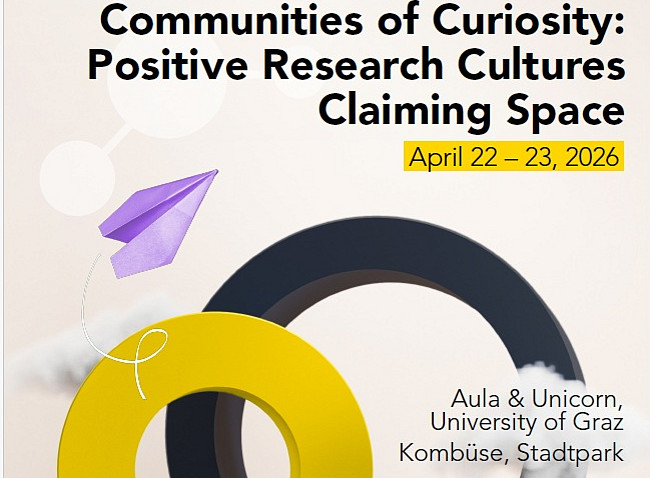
Communities of Curiosity: Positive Research Cultures Claiming Space
April 22 and 23, 2026, Aula & Unicorn, University of Graz
Scroll down for registration. If you require childcare, or know of another way to make this event more accessible for you, get in touch!
Event Hosts: Johanna Stadlbauer (RCC Head) & Gerald Lind (RCC Deputy Head)
April 22, 2026 (AULA, Universitätsplatz 3, 1st floor)
12 pm: Community lunch
1:00 pm: Official Opening
The opening session explores the history and future of researcher development at the University of Graz and talent development in Austrian academia.
Welcome by Rector Peter Riedler (University of Graz)
Why does the Research Careers Campus exist, and what does it offer? Interview with Vice-Rectors Joachim Reidl & Mireille van Poppel
1:30 pm Opening Keynotes: Creating a fair, appreciative, and responsible research culture
This session demonstrates how advocacy for a better academia goes together with institutional management and organizational development.
- From isolation to connection: communities shaping research culture, by Associate Professor, Institute of Education Nicole Brown (University College London)
Researcher development as an enabler of positive research culture, by Head of the Postdoc Academy Steve Joy (University of Cambridge)
2:45 pm Round Table: What nourishes researchers and feeds research creativity?
This session explores conditions that allow researchers to be creative. Perspectives of panelists range from team spirit during the PhD, European and national policy for research environments that spark innovation, to establishing creativity-driven academic spaces within an MSCA project.
Janne Creve, Doctoral Researcher, Functional Diversity and Ecology Research Group, Member of the RCC Strategic Advisory Council (University of Graz)
Carolyn Defrin, MSCA Postdoctoral Fellow and artistic researcher (University of Graz)
Aleksandra Kanjuo-Mrčela, Professor of Sociology (University of Ljubljana)
Thomas König, Managing Director of FORWIT (Vienna)
4:00 pm Intentions for Tomorrow
Geraldine Fitzpatrick (Vienna University of Technology)
April 22, 2026 (KOMBÜSE Graz, Erzherzog-Johann-Allee 2, 8010 Graz, Stadtpark)
6.30 pm to 8.00 pm: 15 Years of Supporting Research Careers
Cake & drinks to celebrate the first 15 years of research career support institutions at the University of Graz
April 23, 2026 (UNICORN, Schubertstrasse 6a, Conference Deck)
10:00 am: Interactive welcome by Johanna Stadlbauer & Gerald Lind (University of Graz)
10:15 am: Panel: How do we personally create positive research cultures?
What are the structures we need to replace and build to allow for productive research? Panelists describe how they shape research culture: As a dean passionate about equality, as a higher education researcher making universities disaster-resilient, as a postdoc with an international outlook, and as a PI and expert for accessibility.
Klemens Fellner, Professor of Mathematics and Dean of the Natural Sciences Faculty (University of Graz)
Verena Régent, Senior Researcher (WPZ Research Gmbh, Vienna)
Katta Spiel, ERC Starting Grantee, member of Austrian Monitoring Committee on the Implementation of the UN Convention on the Rights of People with Disabilities, and ÖAW Young Academy (Vienna University of Technology)
Milica Popović, Senior Postdoctoral Researcher in Cultural Studies (Austrian Academy of Sciences, Vienna)
11:15 pm: Building and replacing: Working groups for a kind academia
Panelists take a deep dive into their area of expertise with interested audience members, facilitated by local higher education experts.
Klemens Fellner & Domenic Hofmann (MedUni Graz)
Verena Régent & Julia Taucher (University of Graz)
Katta Spiel & Silvana Weiss (University of Graz)
Milica Popović & Regina Lammer (University of Graz)
12:00 pm: Short break with finger food
12:30 pm: Collegiality Showcase: The Research Culture and Integrity Ambassadors Introduce Themselves in three minutes
This session showcases projects awarded in November 2025:
Sarah Bürli, Sophie Döhrn and Hannah Schrettle: “From Roots to Words: Rethinking How We Speak About Plants (and Us)”
tbc: “Sermilik Handbook for a Safe, Inclusive and Responsible Arctic Research Culture at the Sermilik Research Station”
tbc: “From Principles to Practice: Fostering Open Science in Graz”
1:00 pm: Your good academic life: small actions, collective impact Keynote and creative space
Geraldine Fitzpatrick (Vienna University of Technology)
2:30 pm Takeaways and Future Plans
This session connects the threads from all the discussions and plots a vision for the future at our university and academia as whole.
Vice-Rector for Internationalisation and Equal Opportunities, Mireille van Poppel (University of Graz)
Register here!
Speaker Biographies:
Nicole Brown is Associate Professor at the UCL Institute of Education in the department of Culture, Communication, and Media. A leading voice in embodied research, she draws on creative, arts-based methods to challenge conventional approaches to researching ableism, disability, chronic illness, and neurodivergence in higher education. Her research foregrounds lived experience and advocates for new ways of listening, speaking, and representing experience that drive cultural, institutional, and structural change. Nicole’s publications include Photovoice Reimagined, Making the Most of Your Research Journal, Lived Experiences of Ableism in Academia: Strategies for Inclusion in Higher Education, and Ableism in Academia: Theorising Experiences of Disabilities and Chronic Illnesses in Higher Education. Her next book will be the creative anthology Exceptionally Able.
Janne Creve is a PhD researcher at the University of Graz, where she studies the effects of climate change on alpine ecosystems. She is the doctoral speaker for the Evolution and Ecology in Changing Environments consortium and represents fellow PhD candidates on the Strategic Advisory Council of the RCC. With a background in bioscience engineering and EU policy-making, Janne is passionate about bridging science and society. Alongside her research, she actively fosters academic community-building and values creativity and interdisciplinary exchange as key drivers of research.
Carolyn Defrin is a Marie Skłodowska Curie Fellow and associated with the University of Graz-based “Elastic Borders: Rethinking the Borders of the 21st Century” project at the Centre for Southeast European Studies. Her research explores how artistic practice can illuminate, express and build understanding across different stakeholders in socio-political contexts. Dr. Defrin received her PhD from London South Bank University in 2021, an MA from Central Saint Martins College of Art (London) and a BA in Drama from Northwestern University (Chicago.) Her artistic work has been awarded funding for example from Chicago’s Department of Cultural Affairs, and Arts Council England.
Klemens Fellner is Professor of Mathematics/Computational Sciences at the Institute of Mathematics and Scientific Computing at the University of Graz. His research group "Applied Analysis and Mathematical Modelling" focuses on the analysis of partial differential equations and the mathematical modelling of various phenomena in physics, (bio)chemistry and (cell)biology. He has been Dean of the Faculty of Natural Sciences at the University of Graz since 2021.
Geraldine Fitzpatrick is Professor i.R. at TU Wien, having led the Human Computer Interaction Group in the Informatics Faculty until Oct 2023. She is an awarded researcher, teacher and leader, with international experience in academia, industry and healthcare, building on a PhD in CS&EE (Uni of Queensland), an MSc in Applied Positive/Coaching Psychology (UEL), and a nursing/midwifery background. She is passionate about developing future academic leaders and crafting more collegial sustainable research cultures. Towards this she now delivers consulting, speaking, training and coaching internationally, and hosts the Changing Academic Life podcast series.
Steve Joy leads the Postdoc Academy, University of Cambridge in its mission to enable postdocs to realise their potential, working across the University and the research sector to inform, develop, advocate alongside, and foster a sense of community with postdocs. In October 2025, he was appointed as the University's LGBTQ+ Equality Champion. Steve was one of the founders of the Future Leaders Fellows Development Network, a national initiative since 2020 to support future research and innovation leaders, where he co-leads the leadership development and coaching programmes.
Aleksandra Kanjuo-Mrčela is professor at the Faculty of Social Sciences, University of Ljubljana. She teaches Sociology of Work, Economic Sociology, Theories of Society and Gender, Work and Organisations. From 2015 to 2021 she was the Head of Doctoral School at the University of Ljubljana and since 2016 a member of the Steering committee of the EUA CDE (European University Association Council of Doctoral Education). From 2017 she is a member of the International scientific committee of the University of Rijeka, Croatia. From 2018 she is a Member of the External Advisory Board of the Doctoral Academy Graz, and now the RCC at the University of Graz. From 2020 she is an external member of the Development Council of the Slovenian Academy of Science and Art.
Thomas König has been Managing Director of the Austrian Council for Research and Technology Development FORWIT since 2024. He studied political science and history in Vienna and Copenhagen. From 2010 to 2014, he was Scientific Advisor to the President of the European Research Council (ERC); after research stays at the Universities of Minnesota and Harvard, among others, he was most recently Head of Strategy and Scientific Services at the Institute for Advanced Studies (IHS). He has published numerous articles on innovation and science policy. His dissertation on transatlantic science diplomacy was published by Studienverlag in 2012 and his book on the creation of the ERC by Polity Press in 2017. König is an experienced science manager and is recognised as an expert on the Austrian and European innovation system.
Milica Popović is Senior Postdoctoral Researcher at the Institute of Culture Studies at the Austrian Academy of Sciences since December 2024, leading her FWF ESPRIT funded project “The Silence of Saying No: (Un)Remembering Deserters from the Yugoslav wars”. Previously, she has been Postdoctoral Fellow and Project Lead at the Global Observatory on Academic Freedom at Central European University in Vienna and for this work, she is a recipient of the DAAD Fundamental Academic Values Award for Early Career Scientists; as well as adjunct lecturer at Sciences Po Paris. She obtained a PhD in Comparative Political Sociology at Sciences Po Paris and in Balkan studies at the University of Ljubljana in 2021. She has also been an expert on the European Higher Education Area for over twenty years
Mireille van Poppel is a medical biologist and has been a professor at the Institute of Exercise Science, Sport and Health since 2015. Integrated in an international network, her focus areas include the role of exercise for prevention, intervention and public health. She is Vice-Rector for Internationalization and Equal Opportunities at the University of Graz.
Katta Spiel's research at Vienna University of Technology concerns marginalised perspectives on embodied computing through a lens of Critical Access, and informs design and engineering supporting the development of technologies that account for the diverse realities they operate in. Katta Spiel is an ERC Starting Grantee, member of the Austrian Monitoring Committee on the Implementation of the UN Convention on the Rights of People with Disabilities, and member of the ÖAW Young Academy.
Peter Riedler, received his doctorate in international and European law from the University of Graz. His professional career took him, among other places, to the European Parliament in Brussels, to the Styrian provincial government, in 2002 to the Federal Chancellery and in 2007 to AVL List GmbH in Graz as Director of Public Affairs. In 2011, Riedler became vice rector, and in December 2021, executive rector. Since October 2022, he has been the elected Rector of the University of Graz.
Joachim Reidl has been a university professor of microbiology at the Institute of Molecular Biosciences at the University of Graz since 2007, where he specialises in bacterial infectiology and the mechanisms of action of antibiotics. He has been Vice-Rector for Research at the University of Graz since May 2021.
Verena Régent holds a PhD in Social and Economic Sciences from Johannes Kepler University Linz. She has several years of experience working on research projects at the intersection of society and technology. Since 2021, she has been a senior scientist at WPZ Research, where she focuses on the national and European research and innovation systems, with a particular emphasis on the higher education sector. In addition to her research activities, she lectures at various Austrian higher education institutions and serves as an external expert for the European Commission and other research funding agencies
Discussion Facilitator Biographies:
Domenic Hofmann, Expert for Doctoral Education, Medical University Graz
Regina Lammer, University of Graz: Registered mediator, psychotherapist in training under supervision, Master of Science in Higher Education and Science Management. Currently working at the “Vertrauensstelle für Konfliktsituationen” and “Psychosocial Counseling Center for Employees” at the University of Graz; a total of 36 years at the university in various roles (BRAUP, Senate, …). Extensive non-university experience (GÖD, lay judge, ...).
Julia Taucher has been coordinating the Welcome Center since its inception in 2016. She completed her Master's degree in English/American Studies at the University of Graz and wrote her Master's thesis on advising international students. In addition to her role at the Welcome Center, she is also the deputy head of the International Office.
Silvana Weiss, University of Graz, Department of Human Resource Management. Research focus: Diversity, Equity & Inclusion (DEI) in organizations and labour markets; work–life balance and boundary work between professional and private life; time and (in)equity; academic careers; gender studies.